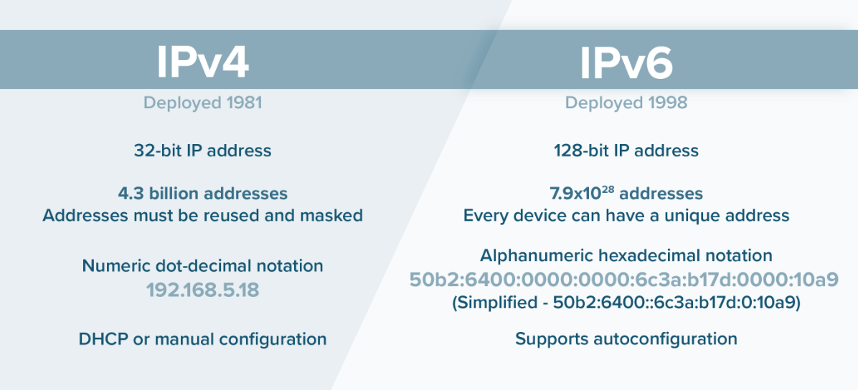
Recently I had to deal with some challenges with IPv6 which prompt me to go ahead and dig in to the topic further and try to play around with it a little bit. While it’s a complex topic to go into details, let’s discuss a few general concepts.

IPv4: Imagine a bustling city with a limited number of addresses. Everyone wants a house, but there aren’t enough unique addresses to go around. This is the situation with IPv4, where we’re running out of unique 32-bit addresses to assign to the ever-growing number of internet-connected devices. IPv4 addresses are like street addresses written in a simple format, easy to read and remember. However, with the address shortage, we’ve had to resort to tricks like Network Address Translation (NAT), where multiple devices share a single public address, much like multiple families crammed into a single house.
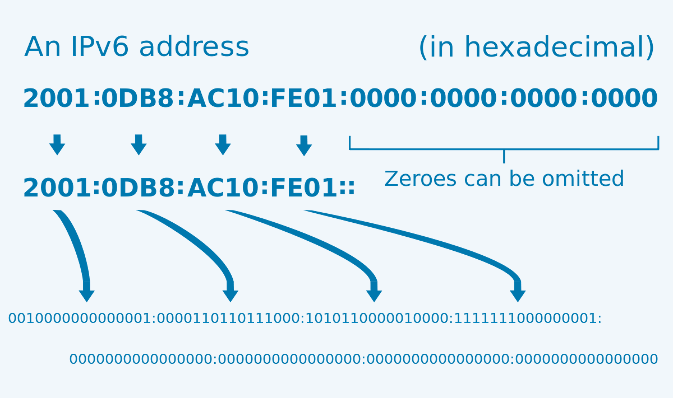
IPv6: Now, envision a sprawling metropolis with an almost infinite number of addresses. Every device, from your smartphone to your smart refrigerator, can have its own unique address. This is the promise of IPv6, which utilizes 128-bit addresses, creating a vast address space that can accommodate the future growth of the internet. IPv6 addresses are like complex coordinates, longer and more intricate, but they ensure that every device has its own distinct identity. With IPv6, we can do away with the NAT workaround and provide each device with a direct connection to the internet, improving efficiency and simplifying network management.
Furthermore, IPv6 comes with enhanced security built-in. It’s like having a security system installed in every house, providing encryption and authentication to protect your data as it travels across the network. IPv6 also supports features like multicasting, which allows for efficient communication with multiple devices at once, much like broadcasting a message over a loudspeaker in a crowded square.
In essence, IPv4 is like an aging city struggling to keep up with the demands of a growing population, while IPv6 is a modern metropolis designed for expansion and innovation. The transition from IPv4 to IPv6 is like moving from an overcrowded town to a spacious city with room to grow. While the move might be challenging (trust me, i know), the benefits of a larger address space, improved security, and advanced features make IPv6 the future of the internet.
A Few interesting comparisons I could dig in:
Address Length:
IPv4: Uses a 32-bit address, typically written in decimal as four numbers separated by periods (e.g., 192.168.1.1). This allows for approximately 4.3 billion unique addresses.
IPv6: Uses a 128-bit address, written in hexadecimal and separated by colons (e.g., 2001:0db8:85a3:0000:0000:8a2e:0370:7334). This allows for an almost unlimited number of unique addresses (around 340 undecillion).
Address Format:
IPv4: Addresses are in the format of XXX.XXX.XXX.XXX, where each XXX is a number between 0 and 255.
IPv6: Addresses are in the format of X:X:X:X:X:X:X:X, where each X is a hexadecimal number representing 16 bits.
Address Space:
IPv4: Limited address space, which has led to the use of techniques like Network Address Translation (NAT) to extend the lifespan of IPv4.
IPv6: Vast address space, designed to accommodate the growing number of devices connected to the internet without the need for NAT.
 Alex Lima
Leave a comment