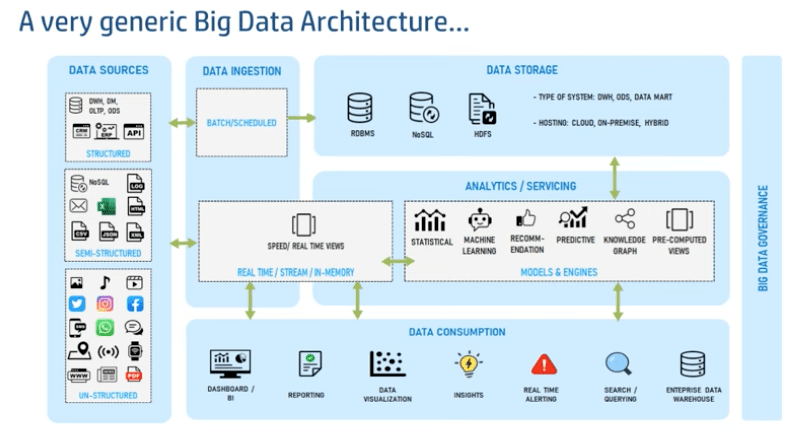

Big Data refers to the huge amount of data that is generated really quickly from lots of different sources. This data is often so big, complicated, and fast that regular data processing methods and tools can’t handle it. Big Data is usually linked to the following characteristics, also known as the “3 Vs”:
- Volume: The sheer amount of data generated and collected today is massive, from social media posts and sensor data to transaction records and scientific research.
- Velocity: Data is generated and flows at unprecedented speeds, often in real-time. This requires systems that can handle and process data on the fly.
- Variety: Data comes in various formats, including structured data (like databases), unstructured data (like text, images, and videos), and semi-structured data (like XML and JSON).
Sometimes, two additional Vs are added to the definition:
- Veracity: This refers to the uncertainty and quality of the data. With such large and diverse datasets, ensuring the accuracy and reliability of data can be challenging.
- Value: The potential insights and business value that can be extracted from analyzing Big Data. Despite the challenges, Big Data offers significant opportunities for businesses, governments, and other organizations to gain insights that were previously impossible to obtain.
Why is Big Data important?

- Insights & Decision Making: By analyzing big data, organizations can gain valuable insights into customer behavior, market trends, and operational efficiencies, enabling them to make better and more informed decisions.
- Innovation & New Products/Services: Big data can be used to identify new opportunities for innovation, leading to the development of new products, services, and business models.
- Improved Efficiency & Cost Savings: Analyzing big data can help organizations optimize processes, streamline operations, and identify cost-saving opportunities.
- Risk Management & Fraud Detection: Big data can help identify patterns and anomalies that may indicate potential risks or fraudulent activity, allowing for proactive risk management and fraud prevention.
- Personalized Experiences: By analyzing individual customer data, businesses can tailor their offerings and create more personalized experiences for their customers.
Challenges of Big Data:
- Storage & Processing: Storing and processing vast amounts of data requires significant infrastructure and computing power. Demands powerful computing resources to process and analyze data quickly.
- Data Quality & Integration: Ensuring data quality, consistency, and integration across different sources can be complex.
- Data Security & Privacy: Protecting sensitive data and ensuring compliance with privacy regulations is crucial.
- Skills & Expertise: Analyzing big data requires specialized skills and expertise in data science, analytics, and technology.
Examples of Big Data Applications:
- Social Media Analytics: Analyzing social media data to understand customer sentiment, identify trends, and measure the effectiveness of marketing campaigns.
- Healthcare Analytics: Analyzing patient data to improve diagnoses, personalize treatment plans, and predict disease outbreaks.
- Financial Analytics: Analyzing financial data to detect fraud, assess risk, and make investment decisions.
- E-commerce Analytics: Analyzing customer browsing and purchase behavior to personalize recommendations and improve sales.
- Smart Cities: Analyzing data from sensors and IoT devices to optimize traffic flow, energy usage, and public safety.
Big Data Technologies:
- Apache Hadoop: An open-source framework for distributed storage and processing of large datasets.
- Apache Spark: A fast and general-purpose engine for large-scale data processing.
- NoSQL databases: Designed to handle flexible and scalable data storage.
- Data visualization tools: Help visualize and interpret complex data.
Big data offers organizations a great chance to uncover useful insights and foster innovation. However, dealing with storage, processing, analysis, and security presents its own set of challenges. By tapping into the right tech and expertise, organizations can fully unlock the power of big data and gain an edge in today’s data-focused world.
I enjoyed this videos about this topic:
 Alex Lima
Leave a comment