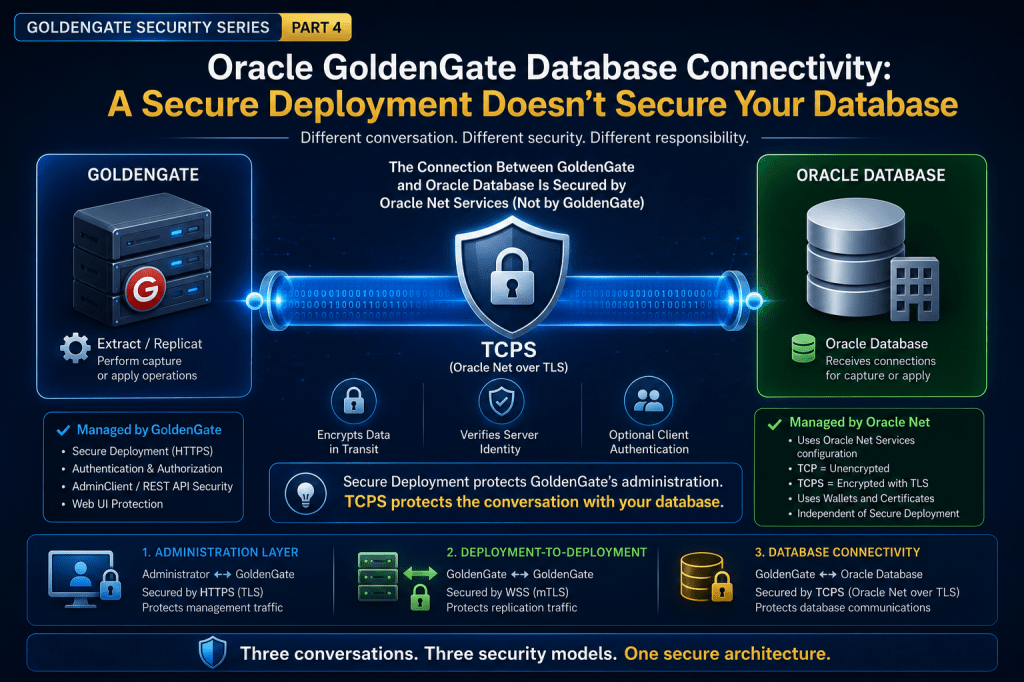
Understanding the difference between securing GoldenGate and securing the connection to Oracle Database.
By now, we’ve covered two important layers of the Oracle GoldenGate security architecture.
In Part 2, we looked at how Secure Deployments protect the administration layer using HTTPS, certificates, and authentication.
In Part 3, we followed the trail records as they moved between GoldenGate deployments over encrypted Distribution Paths using WSS and Mutual TLS.
At this point, many people naturally reach the same conclusion.
“Great… my GoldenGate environment is secure.”
Not quite.
There’s still one very important connection we haven’t talked about.
The connection between GoldenGate and the Oracle Database itself.
Interestingly, this is probably the misconception I encounter most often when discussing GoldenGate security with customers.
Many people assume that because the deployment is secure, the database connection must be secure as well.
They’re actually two completely independent communication paths.
Following the Transaction One Step Further
Let’s continue following the journey of a transaction.
A user updates a row.
Oracle commits the transaction.
Extract captures the redo.
Trail records are generated.
Distribution Service sends them across the network.
Receiver Service receives them.
Replicat prepares to apply the transaction.
And then…
Replicat needs to connect to the Oracle Database.
That connection looks something like this:
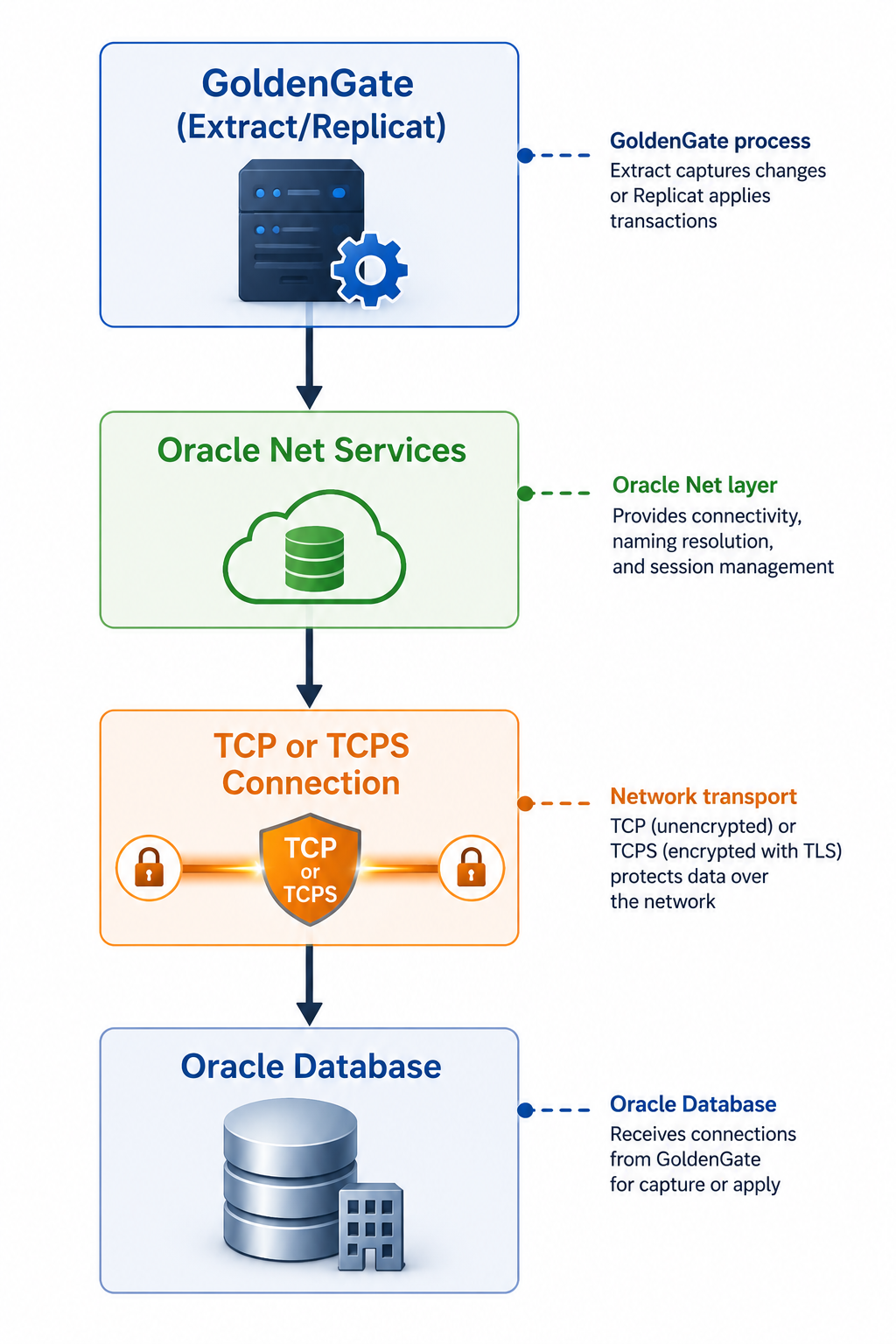
Notice something? The Web UI isn’t involved. The Administration Service isn’t involved. The Distribution Service isn’t involved. This is an entirely separate communication path.
Secure Deployment Stops Here
One of the easiest ways I explain this is by imagining three completely different conversations happening at the same time.
The administrator is talking to GoldenGate.
GoldenGate is talking to another GoldenGate deployment.
GoldenGate is talking to Oracle Database.
Each conversation has its own security model.
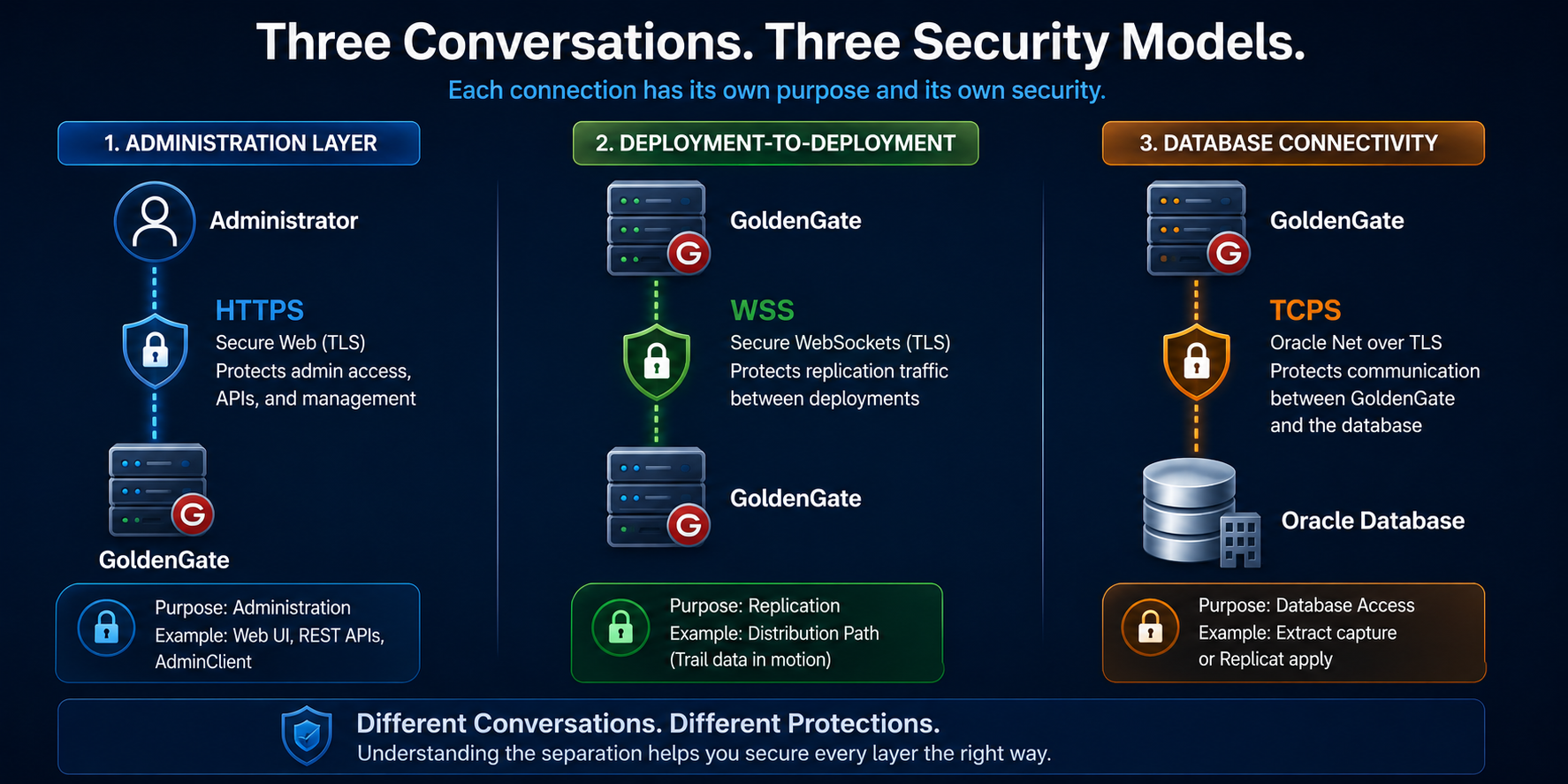
Once you think about it this way, it becomes much easier to understand why enabling HTTPS on your deployment doesn’t automatically encrypt Oracle Net traffic.
They’re different conversations.
So What Actually Secures the Database Connection?
GoldenGate doesn’t invent a new protocol for talking to Oracle Database.
Instead, it relies on the same networking technology every Oracle client uses.
Oracle Net Services.
That means GoldenGate inherits the database connectivity options already available within the Oracle ecosystem.
If Oracle Net is configured using standard TCP, communication remains unencrypted.
If Oracle Net is configured to use TCPS, the connection is encrypted using TLS.
From GoldenGate’s perspective, it’s simply connecting through Oracle Net.
The security is provided by the database networking layer.
I actually like this design because it keeps responsibilities clearly separated.
GoldenGate focuses on replication.
Oracle Net focuses on secure database communication.
Each component does one job well.
Why This Matters
Years ago, many database servers lived inside trusted corporate networks.
Encryption wasn’t always considered essential because the network itself was assumed to be secure.
Today’s environments look very different.
GoldenGate often connects to databases running in:
- Oracle Cloud Infrastructure
- Microsoft Azure
- Amazon Web Services
- Hybrid cloud environments
- Remote disaster recovery sites
In these environments, encrypting the database connection is no longer just a nice feature.
It’s becoming an expectation.
TCP vs TCPS
People sometimes ask me whether switching from TCP to TCPS changes how GoldenGate works.
Operationally, not really.
Extract still captures transactions.
Replicat still applies them.
Checkpoints still work.
Trail files remain unchanged.
What’s different is how the communication is protected while traveling between GoldenGate and the database.
With TCP, packets travel across the network in plain text.
With TCPS, Oracle Net establishes a TLS session before database communication begins.
The replication logic stays exactly the same.
The transport layer becomes secure.
More Than Just Encryption
Just as we discussed in Part 3, encryption is only part of the story.
Certificates also establish trust.
When GoldenGate connects to the database over TCPS, certificates help verify that the database server is really who it claims to be.
Depending on your organization’s security policies, administrators may also choose to authenticate the client using certificates.
This creates a stronger trust relationship between GoldenGate and the database.
Again, notice the pattern.
GoldenGate isn’t implementing its own certificate framework.
It’s taking advantage of Oracle Net’s existing security capabilities.
That consistency is one of the things I appreciate about Oracle’s overall architecture.
Common Misconceptions
Over the years, I’ve heard several misconceptions repeated often enough that they’re worth calling out.
“Secure Deployment encrypts database traffic.”
It doesn’t. Secure Deployment protects the administration layer. Oracle Net secures the database connection.
Those are different components.
“If my database is inside the data center, I don’t need TCPS.”
That depends on your organization’s security requirements.
Many companies now require encryption for all internal communications, regardless of where systems are located.
“GoldenGate manages database certificates.”
Not directly. Certificate management belongs to Oracle Net and your organization’s PKI infrastructure. GoldenGate simply uses the secure connection Oracle Net provides.
Alex’s Take
One thing I’ve always appreciated about Oracle’s architecture is that each component has a clearly defined responsibility.
GoldenGate doesn’t try to become a networking product.
Oracle Net doesn’t try to become a replication engine.
Each layer focuses on what it does best.
As a result, securing a GoldenGate environment isn’t about enabling one feature that magically protects everything.
It’s about understanding each communication path and applying the right security technology to the right place.
Once you start thinking that way, the entire architecture becomes much easier to understand.
Coming Up Next
So far we’ve protected administrators, replication traffic, and database connectivity.
But there’s still one important question left. What happens after the data reaches disk?
In Part 5, we’ll explore Trail File Encryption, discuss the difference between data in motion and data at rest, and explain why protecting stored trail files is just as important as encrypting the network connections that carry them.


Leave a Reply