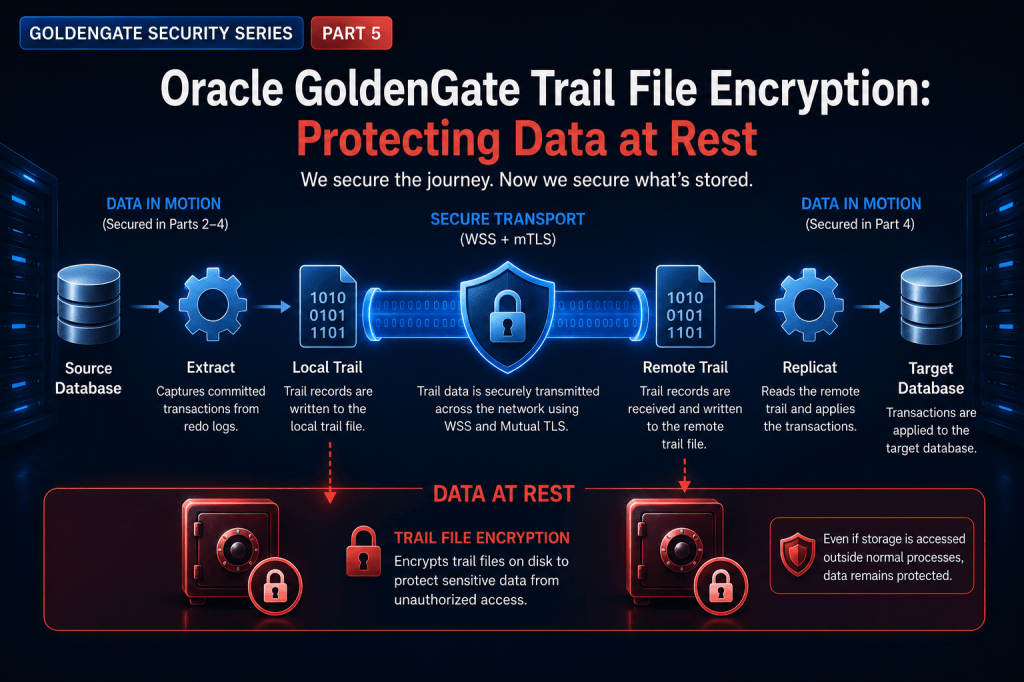
When the data stops moving, security shouldn’t stop with it.
One of the things I’ve enjoyed about writing this series is that it has forced me to think about GoldenGate security the same way I think about a customer architecture review. Instead of looking at individual features, I’ve been following the journey of a transaction.
So far we’ve secured the administration layer with Secure Deployments, protected communication between GoldenGate deployments using WSS and Mutual TLS, and secured the database connection with Oracle Net over TCPS. At this point, it feels like we’ve protected every possible communication path.
But we haven’t.
There’s still one place where your data lives, and interestingly, it’s one that doesn’t come up very often during customer conversations: the trail files themselves.
The Journey Doesn’t End at the Network
When people think about security, they naturally think about networks. We talk about encrypting connections, authenticating systems, and protecting traffic while it’s moving from one place to another. Those are important conversations because data in transit is exposed to interception if the communication channel isn’t properly secured.
Eventually, however, every transaction reaches a point where it stops moving.
Extract captures the change and writes it into a local trail. Distribution Services move those trail records across the network. Receiver Services receive them, and before Replicat applies the transaction, another trail file exists on the target system.
At that moment, the problem changes completely.
We’re no longer talking about data in motion.
We’re talking about data at rest.
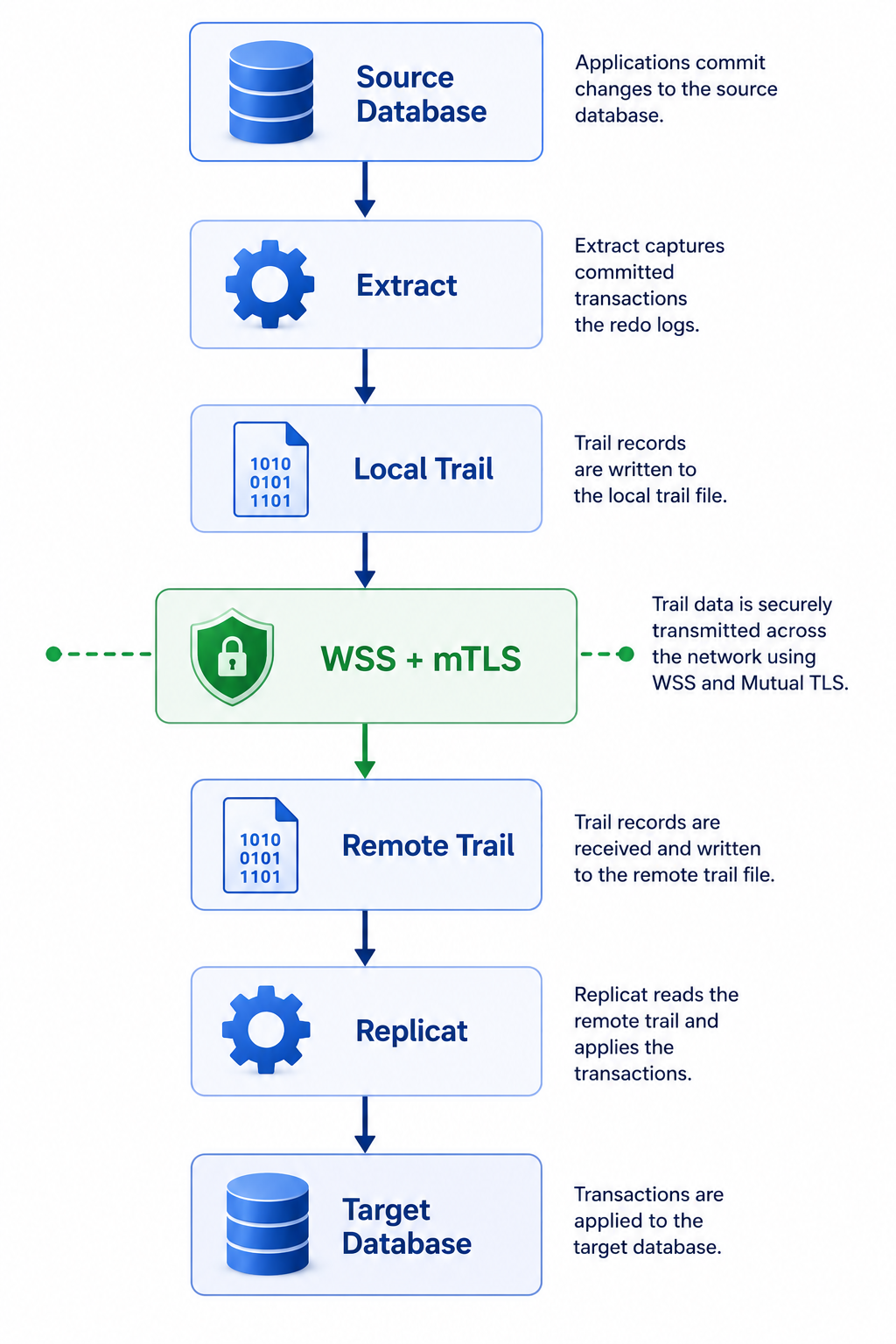
The network encryption we’ve discussed in previous articles has already done its job. The question now is much simpler:
What protects the trail files sitting on disk?
Why Trail Files Matter
One misconception I occasionally hear is that trail files are only temporary working files, so they aren’t really part of the security conversation.
I see them differently.
Trail files are the replication pipeline. Depending on the workload and retention policies, they may remain on disk for minutes, hours, or even days. More importantly, they often contain exactly the same business information you’re trying to protect everywhere else—customer records, financial transactions, healthcare information, personally identifiable information, and other sensitive operational data.
If that information deserves protection while it’s crossing the network, it deserves the same consideration after it’s written to storage.
That’s exactly why GoldenGate supports trail file encryption.
Thinking Beyond the Network
One thing I’ve learned over the years is that good security architecture isn’t built around a single assumption. It’s built around the idea that every layer has a purpose.
You might trust your storage administrators. Your servers may be located inside a secure data center. Operating system permissions may already be well controlled.
All of those things are important. But none of them eliminate the value of encryption. Storage is backed up. Virtual machines are cloned. Snapshots are created. Files are copied for troubleshooting. Disks are replaced.
Trail file encryption isn’t designed because we expect one of those events to become a security incident tomorrow. It’s designed because security works best when it assumes that any individual layer could eventually fail.
That’s the same philosophy we’ve been following throughout this series.
Data in Motion vs. Data at Rest
One of the reasons I like separating these concepts is because they answer two very different questions.
When data is moving, we’re asking:
“Can someone intercept this communication?”
When data is stored, we’re asking:
“What happens if someone gains access to the storage?”
Those are completely different risks, which means they require different security controls.
HTTPS, WSS, Mutual TLS, and TCPS protect communication channels.
Trail file encryption protects the information after the communication has already finished.
Neither replaces the other.
Together, they complete the picture.
It’s About More Than Compliance
Trail encryption is often discussed alongside regulations like PCI DSS, HIPAA, or GDPR. Those are certainly valid drivers, but I don’t think compliance is the most interesting reason to enable it.
Personally, I see trail encryption as another example of layered security.
Throughout this series we’ve looked at different communication paths, and every article has reinforced the same principle: protect each stage of the transaction independently.
Trail files simply happen to represent the final stage before the transaction reaches the target database.
Ignoring that stage would leave a gap in an otherwise well-designed security architecture.
Common Misconceptions
A few assumptions come up often enough that they’re worth calling out.
“The network is encrypted, so the trail files must be encrypted too.”
Not necessarily. Network encryption protects communication while data is moving. Trail file encryption protects the files after they’re written to disk.
“Trail files only exist briefly, so encryption isn’t worth it.”
That depends entirely on your workload and operational practices. In many environments, trail files remain available much longer than people expect.
“Operating system permissions provide enough protection.”
Operating system security is an important layer, but encryption provides protection even if those permissions are bypassed or storage is accessed outside normal operating procedures.
Alex’s Take
One thing this series has reinforced for me is that good security architecture isn’t about finding the strongest single feature. It’s about making sure every stage of the journey has an appropriate level of protection.
- Trail file encryption is a perfect example of that philosophy
- It’s not replacing operating system security
- It’s not replacing storage security
- It’s adding another independent layer that protects your data long after the network conversation has ended
To me, that’s what defense in depth really means.
Coming Up Next
So far we’ve focused on protecting the administrator, the communication channels, the database connection, and the trail files themselves.
The final piece of the puzzle isn’t encryption at all.
It’s identity.
In Part 6, we’ll shift our attention to authentication and authorization, exploring how Oracle GoldenGate integrates with enterprise identity providers, role-based access control, Microsoft Entra ID, Oracle Identity Domains, and LDAP. After all, before deciding how to secure your environment, you first need to decide who should be allowed to manage it.


Leave a comment