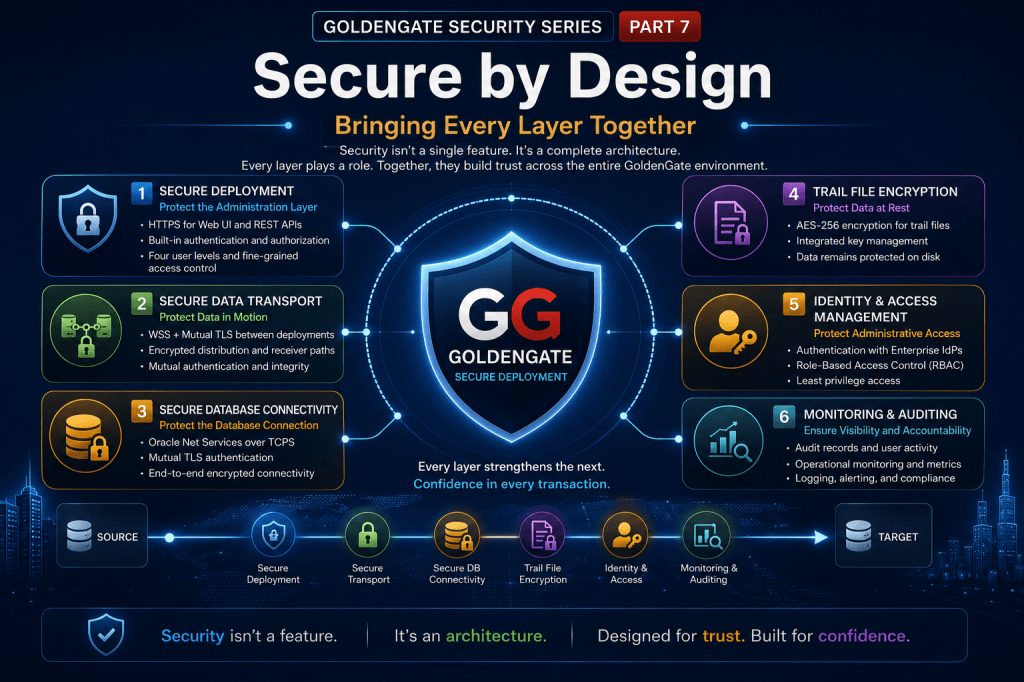
Bringing Every Layer Together
When I started writing this series, my goal wasn’t to explain every security feature in Oracle GoldenGate. The product documentation already does an excellent job of describing how to configure TLS, create users, encrypt trail files, or integrate with enterprise Identity Providers.
What I wanted to explore was something different.
Why those features exist.
Over the years, I’ve noticed that many security discussions begin by asking, “Which feature should I enable?” It’s a natural question, but I don’t think it’s the right one.
Security isn’t built by enabling a feature.
It’s built by designing an architecture.
Throughout this series, we’ve followed the journey of a transaction from the moment an administrator connects to a deployment until that transaction safely reaches its destination. Along the way, we’ve seen that every step introduces a different security challenge, and every challenge deserves its own layer of protection.
We started with Secure Deployments, because every environment needs a protected administration layer. HTTPS secures access to the Web UI and REST APIs, while built-in authentication and authorization establish the first level of trust before any administrative operation takes place.
From there, we looked at secure data transport. Once replication leaves one deployment and travels to another, the conversation changes from protecting administrators to protecting data in motion. WSS combined with Mutual TLS ensures that both deployments authenticate each other before exchanging trail data, preserving confidentiality, integrity, and trust throughout the replication path.
Next came database connectivity. One of the most common misconceptions I encounter is the assumption that a secure deployment automatically means the database connection is encrypted. It doesn’t. Oracle Net Services is responsible for protecting communication between GoldenGate and Oracle Database, making TCPS another independent layer of the overall architecture.
We then shifted our attention to data at rest. Trail files often contain the same sensitive business information that exists in the source database, and once they’re written to disk they deserve the same level of protection as any other enterprise data. Trail file encryption ensures that information remains protected even when it’s no longer moving across the network.
Our most recent discussion focused on Identity and Access Management. Modern enterprise security isn’t simply about protecting networks anymore; it’s about protecting identities. GoldenGate integrates with supported enterprise Identity Providers while applying Role-Based Access Control to ensure authenticated users receive only the permissions required for their responsibilities. Strong authentication and least-privilege authorization are every bit as important as encrypted communication.
If I were adding one final layer to this architecture, it would be visibility.
No matter how secure an environment appears, administrators still need to know what’s happening. Audit records, operational monitoring, metrics, and logging provide the confidence that security controls are working as expected and help organizations investigate problems when they aren’t. Security isn’t just about preventing unauthorized activity—it’s also about knowing when something unexpected occurs.
Looking back, something becomes very clear.
Each of these layers solves a completely different problem.
Secure Deployments protect administration.
WSS protects data in motion.
TCPS protects database communication.
Trail encryption protects data at rest.
Identity and Access Management protects administrative access.
Monitoring and auditing provide accountability.
None of these features replace one another.
They complement one another.
That’s why I often say that Oracle GoldenGate security isn’t a collection of independent features. It’s a collection of architectural decisions that work together to build trust across the entire replication environment.
One Final Thought
One of the questions I hear most often is:
“What’s the most important security feature in GoldenGate?”
After working with customers for many years, I don’t think there’s a single answer.
HTTPS without Role-Based Access Control isn’t enough.
Role-Based Access Control without trusted identities isn’t enough.
Trail file encryption without secure transport leaves another gap.
Secure transport without encrypted database connectivity still exposes another communication path.
Every layer strengthens the next.
That’s what makes the architecture resilient.
To me, that’s the real lesson behind this series.
Good security isn’t achieved by checking a box or enabling a single option. It’s the result of thoughtful design, where every layer contributes to the overall confidence of the system.
If there’s one idea I’d like readers to remember, it’s the same one that inspired the very first article:
Security isn’t a feature. It’s an architecture.
Thank you for following along on this journey. I hope these articles have helped explain not just how Oracle GoldenGate secures enterprise data, but why it was designed that way.
Because when security is designed into every layer from the beginning, it stops being something you add later.
It simply becomes part of the architecture.


Leave a Reply