The strongest encryption in the world won’t help if the wrong person has administrator access.
Over the last five articles, we’ve been following the journey of a transaction through Oracle GoldenGate. We secured the administration layer with Secure Deployments, protected communication between deployments using WSS and Mutual TLS, encrypted database connectivity with Oracle Net over TCPS, and finally looked at protecting trail files once they’re written to disk.
At this point, we’ve talked a lot about encryption.
But there’s one part of the architecture we haven’t really talked about yet.
The person sitting behind the keyboard.
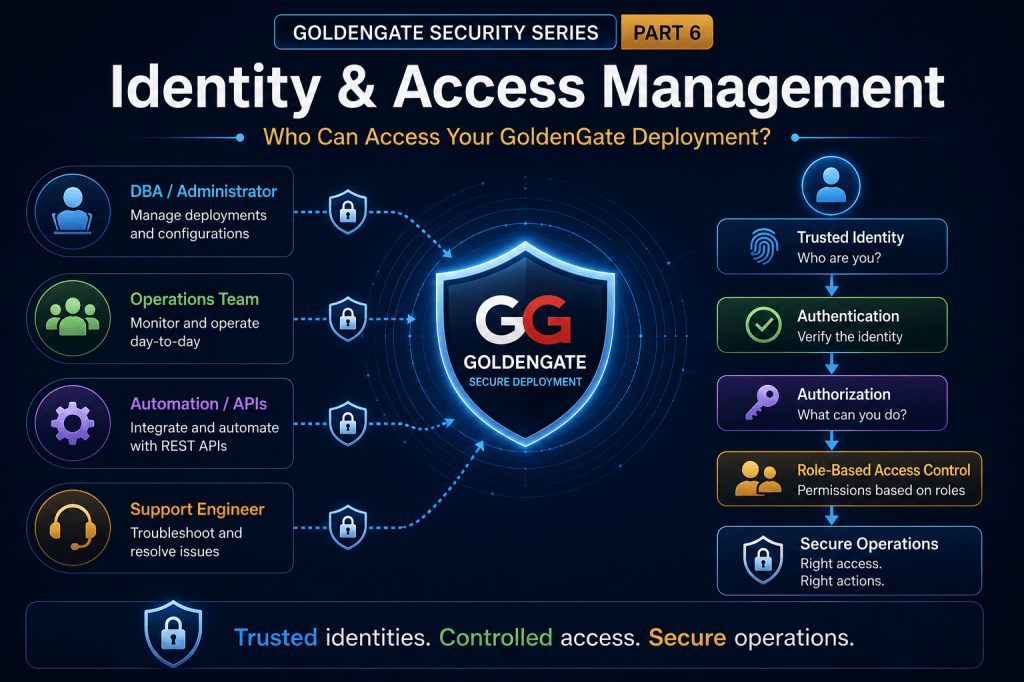
Every administrative action begins with someone or something requesting access. It might be a DBA opening the Web UI, an operations engineer using AdminClient, an automation platform calling the REST APIs, or a monitoring solution collecting metrics. Before GoldenGate can decide what action to perform, it first has to answer a much simpler question:
Who is asking?
Security Is About People Too
One thing I’ve learned from working with enterprise customers is that security discussions almost always begin with technology. People ask about TLS, certificates, firewalls, or encrypted communication. Those are important topics, but they all assume something has already happened.
Someone has already logged in.
Identity management starts one step earlier.
Before establishing an encrypted session or executing a command, GoldenGate needs to establish trust. It needs to know who’s requesting access, whether that identity is legitimate, and what permissions should be granted. That’s where authentication and authorization become just as important as encryption itself.
Although those terms are often used together, they’re solving two different problems. Authentication answers “Who are you?” Authorization answers “Now that I know who you are, what are you allowed to do?” A secure architecture needs both.
GoldenGate Fits Into Your Identity Strategy
Years ago, every application seemed to have its own list of users and passwords. Administrators ended up maintaining credentials separately for every product they deployed. It worked, but it also created unnecessary complexity and increased the number of identities that had to be managed.
Today’s enterprise environments look very different.
Most organizations already have an established identity platform that employees use to access email, cloud services, internal applications, and development tools. Password policies, multi-factor authentication, account provisioning, and user lifecycle management are all handled centrally.
Personally, I think enterprise software should integrate into that existing ecosystem instead of trying to replace it.
That’s exactly the approach GoldenGate takes.
Rather than creating another isolated authentication system, Oracle GoldenGate integrates with supported enterprise Identity Providers, including Oracle Identity Domains, Microsoft Entra ID, and Oracle Access Manager. Authentication remains part of the organization’s existing identity infrastructure, allowing administrators to leverage the same trusted identities and corporate security policies already in place across the enterprise.
To me, that’s the right architectural decision. GoldenGate focuses on securely moving data, while identity platforms continue doing what they do best—managing identities, enforcing authentication policies, and controlling user lifecycle.
Authentication Is Only the Beginning
Successfully logging in doesn’t automatically mean someone should have unrestricted access.
Think about a typical GoldenGate environment.
A junior administrator may only need to monitor process status.
An operations team might need to start and stop Extracts.
A senior administrator may be responsible for creating deployments or managing users.
An automation platform may only require permission to execute a specific set of REST API operations.
Treating all of these identities the same would make administration easier, but it would also introduce unnecessary risk.
This is where Role-Based Access Control (RBAC) becomes so valuable. GoldenGate delegates authentication to the organization’s supported Identity Provider, then applies its own authorization model to determine what authenticated users are allowed to do within the deployment.
Instead of assigning permissions one user at a time, administrators assign roles based on responsibilities.
People receive the permissions required for their job—and nothing more.
It’s a simple concept, but one that dramatically improves the overall security posture of an environment.
Identity Has Become the New Security Perimeter
One of the biggest changes I’ve noticed over the last decade isn’t actually in GoldenGate.
It’s in the environments where GoldenGate runs.
Organizations have embraced cloud services, hybrid architectures, remote administration, automation pipelines, and API-driven operations.
GoldenGate is no longer administered exclusively from a terminal sitting inside a secure data center.
Administrators connect from laptops.
Automation tools execute REST API calls.
Monitoring platforms continuously retrieve metrics.
Identity has become the foundation that ties all of those interactions together.
In many ways, modern security has shifted from protecting networks to protecting identities.
I think that’s one of the biggest changes in enterprise security over the last several years.
Security Through Integration
One thing I’ve always appreciated about GoldenGate’s approach is that it doesn’t try to replace an organization’s existing identity strategy.
It works with it.
Corporate authentication policies remain centralized.
Multi-factor authentication continues to be enforced by the organization’s Identity Provider.
User provisioning and lifecycle management stay under enterprise control.
GoldenGate simply consumes those trusted identities and applies its own authorization model through RBAC to determine what authenticated users are permitted to do.
That separation keeps the architecture clean and allows organizations to adopt GoldenGate without redesigning their existing identity infrastructure.
Alex’s Take
When I review a customer’s GoldenGate environment, one of the first questions I ask isn’t about TLS or certificates.
It’s much simpler.
“Who can access your deployment?”
The answer usually tells me a lot about the overall security architecture.
Strong encryption is essential.
Secure networking is essential.
Trail file encryption is essential.
But none of those technologies replace good identity management.
At the end of the day, every administrative action begins with a person or a trusted service requesting access.
Making sure that identity is trusted, authenticated, and appropriately authorized is one of the most important security decisions an organization can make.
Coming Up Next
We’ve now covered every major layer of the GoldenGate security architecture, from administration and networking to storage and identity.
In the final article of this series, we’ll bring everything together and look at what a fully secured Oracle GoldenGate deployment looks like in practice. We’ll revisit each layer, discuss how they work together, and share a practical checklist that I use when thinking about secure GoldenGate architectures.


Leave a comment